
Identify ASD Early Risk Within Weeks of Birth – Not Years
Our autism risk test, ASD Insight™, is designed to provide assessment of early autism risk detection by analyzing a simple skin sample collected from an individual of any age.

Learn more about ASD Insight™
Hear how the test can give your family options and peace of mind.
The Science Behind The Test
The first-of-its-kind ASD Insight™ test detects a biological marker in skin cells that identifies a marker related to calcium signaling that is altered in signal processing in the autism spectrum disorder brain.

How the ASD Insight™ Early Autism Risk Detection Test Works

Tissue sample from skin punch biopsy or discarded foreskin is collected.

The sample is sent to NeuroQure's lab for processing.

The sample is analyzed using our patented technique.

Results are provided within weeks to the online portal.
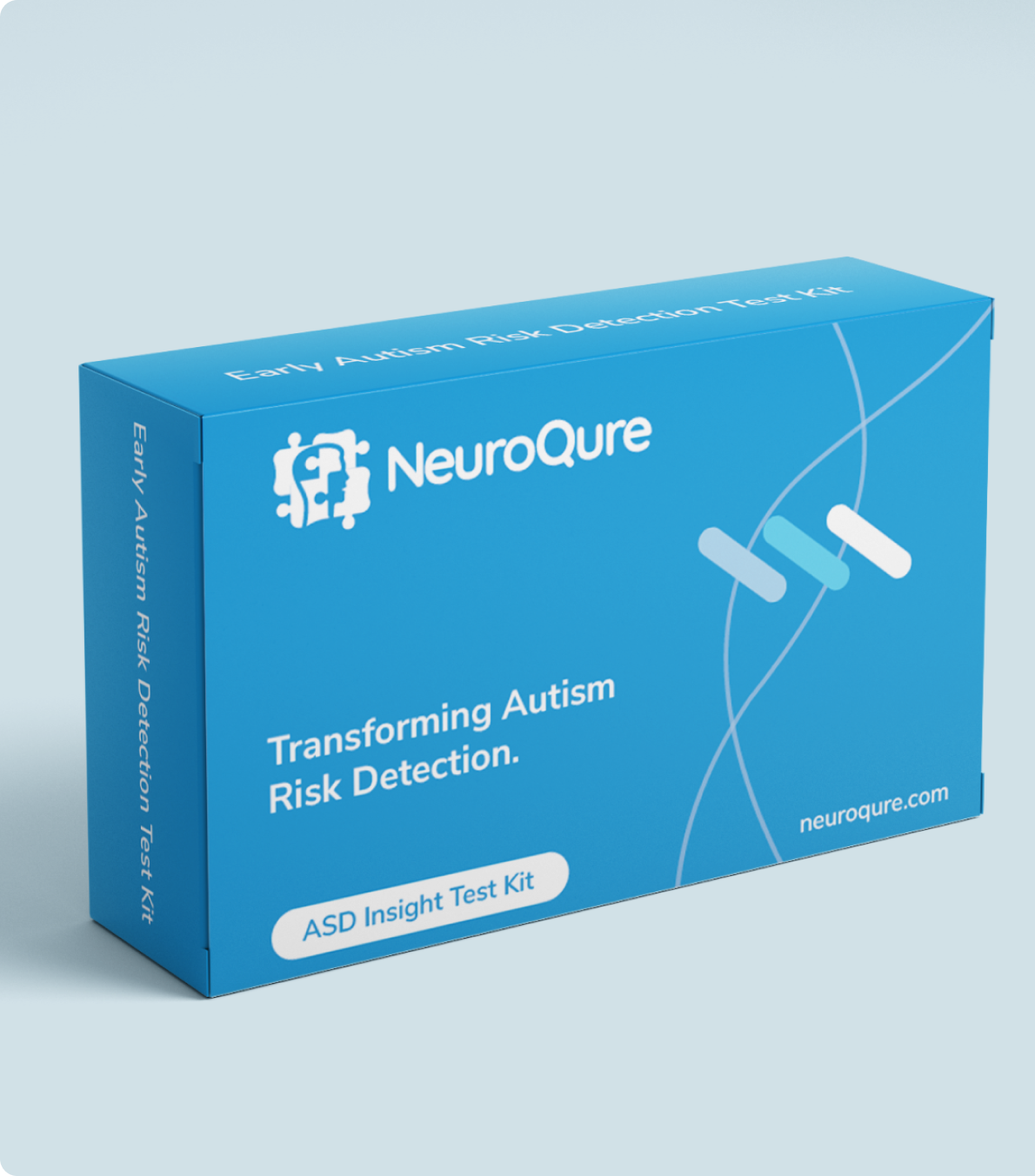
What To Know About ASD Insight™

Earliest Availability: Available from birth onward, well before behavioral signs of autism are detected on diagnostics assessments, which are not available until 18-24 months.
Minimally Invasive: Uses a small sample of skin from a punch biopsy or leftover foreskin from circumcision.
Rapid Results: Get answers within weeks, not years.
Proprietary Methodology: First-of-its-kind test.
Expert Backed: Clinically approved and developed by world known John J. Gargus, MD, PhD, our Co-Founder and Chief Scientific Officer.
The Importance of Early Autism Detection
Early detection of autism spectrum disorder (ASD) has been proven to significantly improve outcomes for children compared to those diagnosed later in childhood. By identifying risk factors early, families can access resources and interventions that support development and learning.
Studies have shown that children diagnosed at the earliest possible age (2 years) versus those diagnosed at the current average age (5 years) can see a noticeable IQ improvement by 17 points.

- General information: Autism spectrum disorder (ASD) had no defined biomarkers for diagnostics or novel drug discovery. A major cluster of ASD-associated loci encode calcium signaling proteins. Functional measurement of these signals in fibroblasts shows altered intracellular Ca2+ release in monogenic syndromes associated with ASD (FMR1, TSC1, TSC2, etc.), as well as sporadic ASD. Ca2+ channels in these patients demonstrate a reduced mean open-time and therefore low flux, while other measurable parameters, such as channel abundance, selectivity, conductance, and latency, are unchanged. This result is similar to single-channel kinetic changes seen in genetic channelopathies.
- Methodology: The skin biopsy is processed using enzymatic dissociation and fibroblasts are cultured in standard medium. Cultured cells are plated in triplicate along with controls and then subjected to stimulation of Ca2+ signaling with ATP, ionomycin and buffer. All triplicates are averaged and normalized to a baseline based on triplicate controls included on each plate. The Ca2+ signal and closure of the calcium channel is calculated based on a previously published algorithm (Schmunk et al.) and reported as detected or not detected based on the rate of calcium flux on closure as compared to controls. The reference range is not detected based on the measured calcium flux, which is physiologic and in the range of that seen in neurotypical controls.
- References: Schmunk G, Nguyen RL, Ferguson DL, Kumar K, Parker I, Gargus JJ. High-throughput screen detects calcium signaling dysfunction in typical sporadic autism spectrum disorder. Sci Rep. 2017;7:40740 Nguyen RL, Medvedeva YV, Ayyagari TE, Schmunk G, Gargus JJ. Intracellular calcium dysregulation in autism spectrum disorder: An analysis of converging organelle signaling pathways. Biochim Biophys Acta Mol Cell Res. 2018;1865(11 Pt B):1718-1732.Schmunk G, Boubion BJ, Smith IF, Parker I, Gargus JJ. Shared functional defect in IP3R-mediated calcium signaling in diverse monogenic autism syndromes. Transl Psychiatry. 2015;5(9):e643.
- Disclaimer: ASD Insight™ was developed and its performance characteristics were determined by NeuroQure, Inc, a clinical laboratory. It has not been cleared or approved by the US Food and Drug Administration. This test is used for clinical purposes. It should not be regarded as investigational or for research.

Empower Early Risk Detection, Transform Lives
Get started with NeuroQure's ASD Insight™ autism risk test today.